A stone house brings to mind thick walls, cool interiors and façades that defy the years. In Anatolia, stone has been used for thousands of years as a local, climate-appropriate and durable material. Every region has its own stone, colour and craftsmanship. Anyone who wants to build a stone house today needs to understand this heritage and also choose a system that meets the current earthquake code.
Stones by Region
- Cappadocia (Nevşehir, Kayseri, Niğde): volcanic tuff. A soft stone formed from the ash of the Erciyes, Hasandağı and Göllüdağ volcanoes. It is easy to cut and carve when quarried and hardens on contact with air. It is light and insulates well. The carved and cut-stone houses of Cappadocia are built with it. Darker, brownish tuffs are common in Kayseri.
- Mardin and Midyat: limestone (Mardin stone, Midyat stone). A fine-grained limestone in yellow and honey tones. Being soft, it suits fine carving and ornament and hardens over time. Mardin’s terraced stone mansions and Midyat’s carved façades are made of it.
- Ahlat (Bitlis): Ahlat stone. A volcanic stone (ignimbrite) from Mount Nemrut in red, brown and black tones. Light, porous and well insulating, it suits cold climates. Today it is used as façade cladding all over Türkiye.
- Diyarbakır: basalt. A black, very hard and heavy stone from the Karacadağ volcano. The walls and historic houses of Diyarbakır are built of basalt. It is hard to work but highly resistant to wear and frost.
- Şanlıurfa: Urfa stone (limestone). An easily cut limestone in cream and white tones. Urfa’s courtyard houses and the buildings of the Harran region are built with it, and it keeps interiors cool in the hot climate.
- The Aegean coast (Alaçatı, Bodrum, Datça): local limestone and volcanic stone. The yellowish cut-stone houses of Alaçatı and the whitewashed or bare rubble stone walls of Bodrum and Datça define the character of the region.
- The Black Sea: stone and timber together. Because of the wet climate, ground floors and foundations are usually stone and upper floors timber. The “göz dolma” technique, where a timber frame is infilled with stone, is typical of the region.
- Istanbul and the Marmara region: Kandıra stone and marbles. Cream and yellow Kandıra stone from the Kocaeli area is widely used in Istanbul for façades and garden walls. Marble from Marmara Island has been used in palaces and mosques throughout history.
Beyond these, Denizli travertine, Afyon and Muğla marbles and andesite, found in many parts of Anatolia, are widely used for façade and floor finishes.
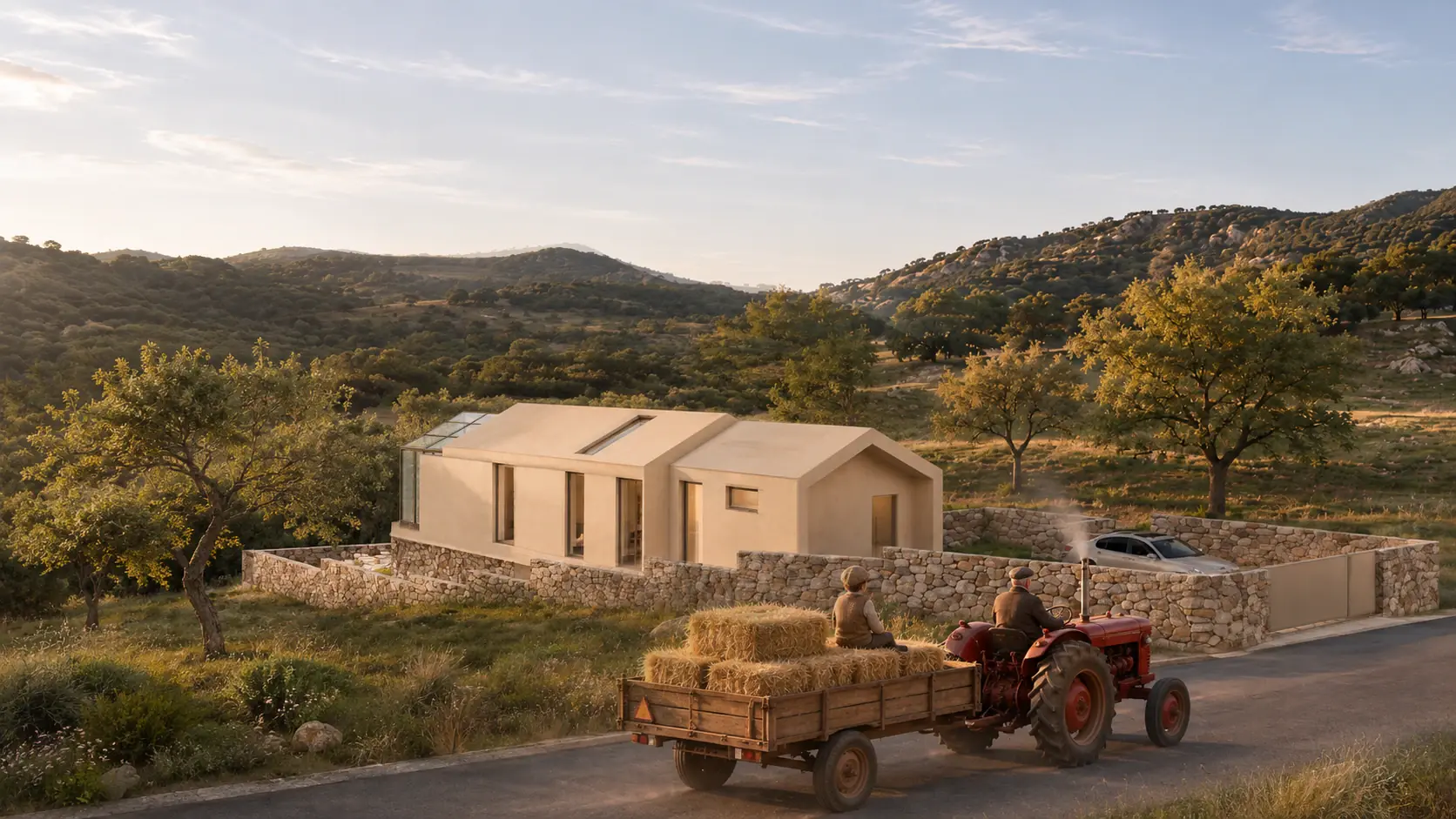
How Is a Stone House Built? Two Ways
- Load-bearing masonry: the walls themselves carry the building. This is the traditional method, with walls usually 50 cm thick or more. The Turkish Building Earthquake Code limits the number of storeys, wall openings and wall ratios in masonry buildings and requires measures such as bond beams and slab connections. Done correctly, it suits low-rise buildings, but it needs skilled masons and careful supervision.
- Concrete or steel frame with stone cladding: the structure is reinforced concrete or steel, and stone is used as cladding on the façade. Most stone houses built today use this method. Earthquake safety comes from the structural frame, while the stone provides appearance and durability. Cladding can be fixed with mortar or with stainless anchors as a ventilated façade.
Advantages of Stone
- Thermal mass: a thick stone wall stores heat during the day and releases it slowly at night, keeping interiors cool in summer and more stable in winter.
- Durability: well-chosen stone lasts for centuries and needs little maintenance.
- Local character: stone from a nearby quarry lowers transport costs and ties the building to its surroundings.
- Timeless appearance: stone gets more beautiful with age and never goes out of fashion.
What to Watch For
- Choose the right stone: porous, soft stones can be damaged by freeze and thaw in cold, wet regions. Ask for the water absorption and compressive strength values.
- Damp and insulation: a stone wall alone may not meet today’s thermal standards. Insulation should be added on the inside or with a façade system, and damp-proofing should protect against rising moisture.
- Joints and mortar: use a breathable mortar compatible with the stone. A very hard cement mortar can cause the stone to crack, especially in old buildings.
- Craft and detail: stonework requires expertise. Corners, window surrounds and parapets should be drawn in advance and a sample wall built and approved.
- Zoning and conservation areas: in protected areas and some municipalities there are special rules on façade material, stone type and colour. Check before the design starts.
Cost of a Stone House
The cost of a stone house depends mostly on the type and thickness of the stone, the workmanship and the method. According to price lists from June 2026, natural stone cladding costs roughly 1,250 to 4,000 TL per m² for materials, with installation at 700 to 2,000 TL per m². Solid cut stone, labour-intensive rubble walls and stone brought from distant regions can go well above this range. With a frame and stone cladding, the overall budget is the cost of a building of the same size plus the difference for the façade. For a precise budget, choose the stone, then get samples and quotes.
Conclusion
Chosen and detailed correctly, stone makes a home both beautiful and long-lasting. Knowing the stone of the region, combining it with a modern structural system and supervising the workmanship well are the keys to a successful stone house. Get in touch about your stone house project, or get a preliminary estimate from our cost calculator.
This article is for general information only. Costs are based on 2026 price lists and vary with the type of stone, location and installation.